

Our Commitment to Excellence and Reaffirmation
Five Towns College proudly begins the self-study process in pursuit of reaffirmation of accreditation by the Middle States Commission on Higher Education (MSCHE). This effort reflects our deep commitment to our mission and provides an opportunity to strengthen institutional goals, assess progress, and affirm our dedication to academic quality, student development, and continuous improvement.
Reaccreditation is a moment to pause and reflect—not just on where we’ve been, but on where we’re headed. It allows us to evaluate our programs, services, and strategies with honesty and transparency, and to ensure that we are meeting the evolving needs of our students and community.
MSCHE, recognized by the U.S. Department of Education, serves as a leading voice in higher education accreditation. The Commission evaluates institutions holistically, including all academic offerings and services—on campus, online, and beyond. Through peer review and assessment, MSCHE supports colleges like Five Towns in maintaining integrity, accountability, and innovation in a rapidly changing educational landscape.
Please review: MSCHE Standards of Accreditation and Evidence Expectations by standard.
By participating in this process, Five Towns College reaffirms its place as a vibrant, student-centered institution committed to excellence today—and into the future.
Five Towns College’s current accreditation status is displayed on the institution’s Statement of Accreditation Status (SAS) page.



Accreditation Overview
- Five Towns College will undergo its reaffirmation of accreditation with the Middle States Commission on Higher Education, a process that is on an eight-year cycle, in the 2026-27 Academic Year.
- According to the MSCHE, an institution of higher education is a community dedicated to students, to the pursuit and dissemination of knowledge, to the study and clarification of values, and to the advancement of the society it serves.
- MSCHE requires that its institutions meet rigorous and comprehensive accreditation standards for higher education. It evaluates higher education institutions based on mission, ethics, student learning, and resources, aiming to support continuous improvement. The ultimate goal is to enhance educational quality and ensure institutions are accountable to students and the public.
- An institution is accredited when the educational community has confirmed through self-reflection and peer review that its mission is achieved and progress is made toward institutional goals.
- Accredited institutions pursue excellence and innovation at all levels through ongoing quality assurance, improvement, innovation, and systematic, periodic, and sustained assessment.
- Effective, July 1, 2023, institutions are expected to follow the 14th Edition of the Standards for Accreditation and Requirements of Affiliation.
- Co-Chairs of the MSCHE Steering Committee: Provost Marsha Pollard and Dr. Joshua Dinsman
This dropdown menu will contain the following:
- Document and plans related to self-study preparation
- Middle States Evaluation Team Site Visit Dates, Schedule, Purpose and Description
Mission Statement:
Five Towns College is a creative learning community that develops in students the knowledge, skills, and competencies necessary to pursue careers in the performing arts, media and communications, business and industry, and the teaching professions. Through programs that combine general education and content specialty areas, the undergraduate and graduate curricula integrate rigorous academic inquiry, industry standard technologies and facilities, experiential learning, and respect for diversity and ethical values. In so doing, the College helps each student to expand their unique talents to the fullest, while also preparing graduates to contribute to the advancement of society.
Institutional Goals:
- To develop in undergraduate students college-level proficiencies in general education;
- To develop in undergraduate students content expertise within the context of specific career objective;
- To strengthen graduate students’ professional-level proficiencies in content-specific area; and
- To engage in strategic planning activities that nurture a culture dedicated to institutional and student learning assessment, and leads to clearly articulated student achievement outcomes.
Adopted April 27, 2017 by the Five Towns College Board of Trustees effective July 1, 2017
Five Towns College, through strategic brainstorming sessions via an inductive qualitative methodology, has developed five Institutional Priorities to be addressed throughout the self-study process, including:
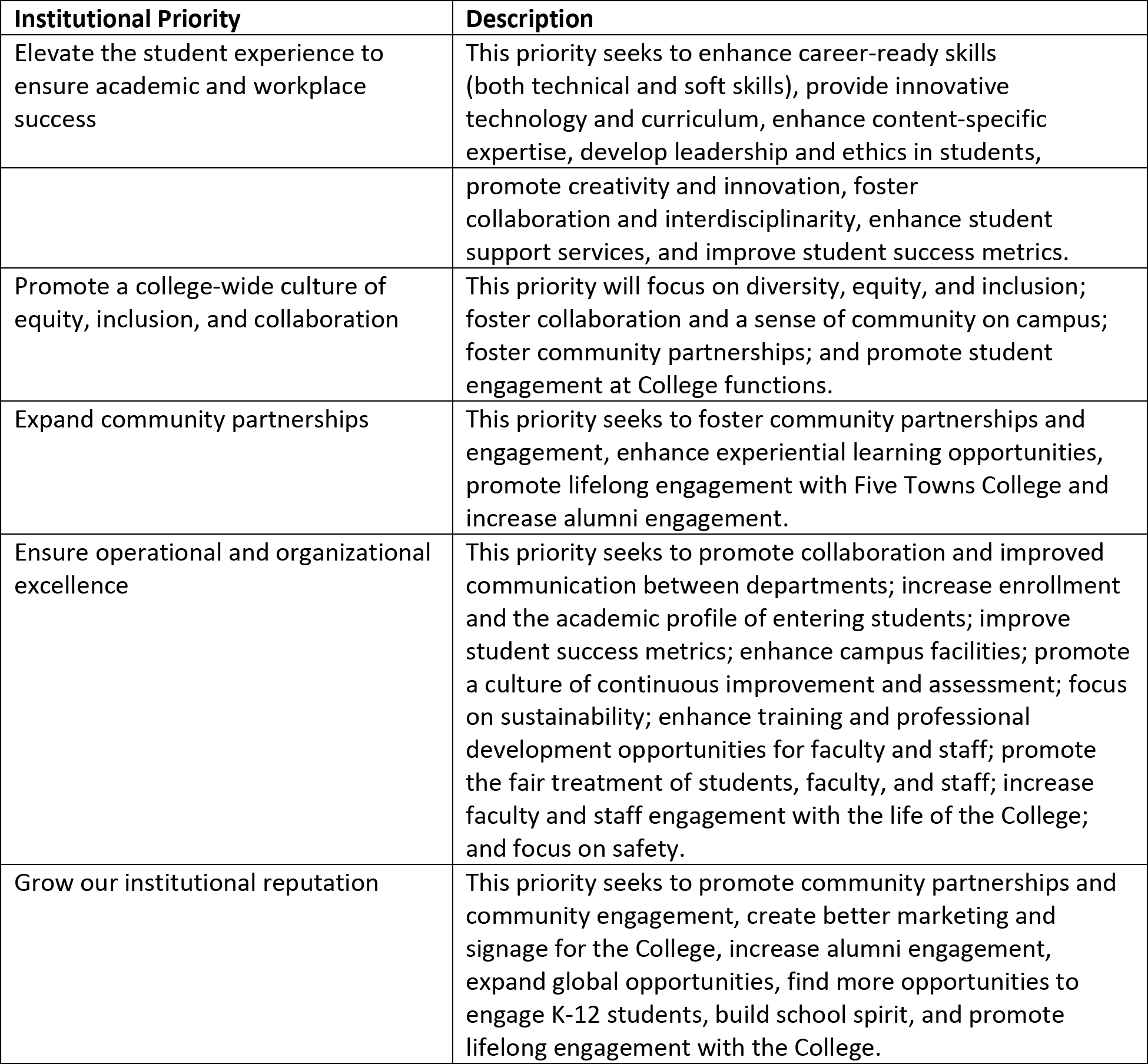
Five Towns College has established an Accreditation Steering Committee and seven Working Groups, one for each of the seven Standards, to lead and write the Self-Study Report and to prepare for the Spring 2027 team site visit.
The Steering Committee
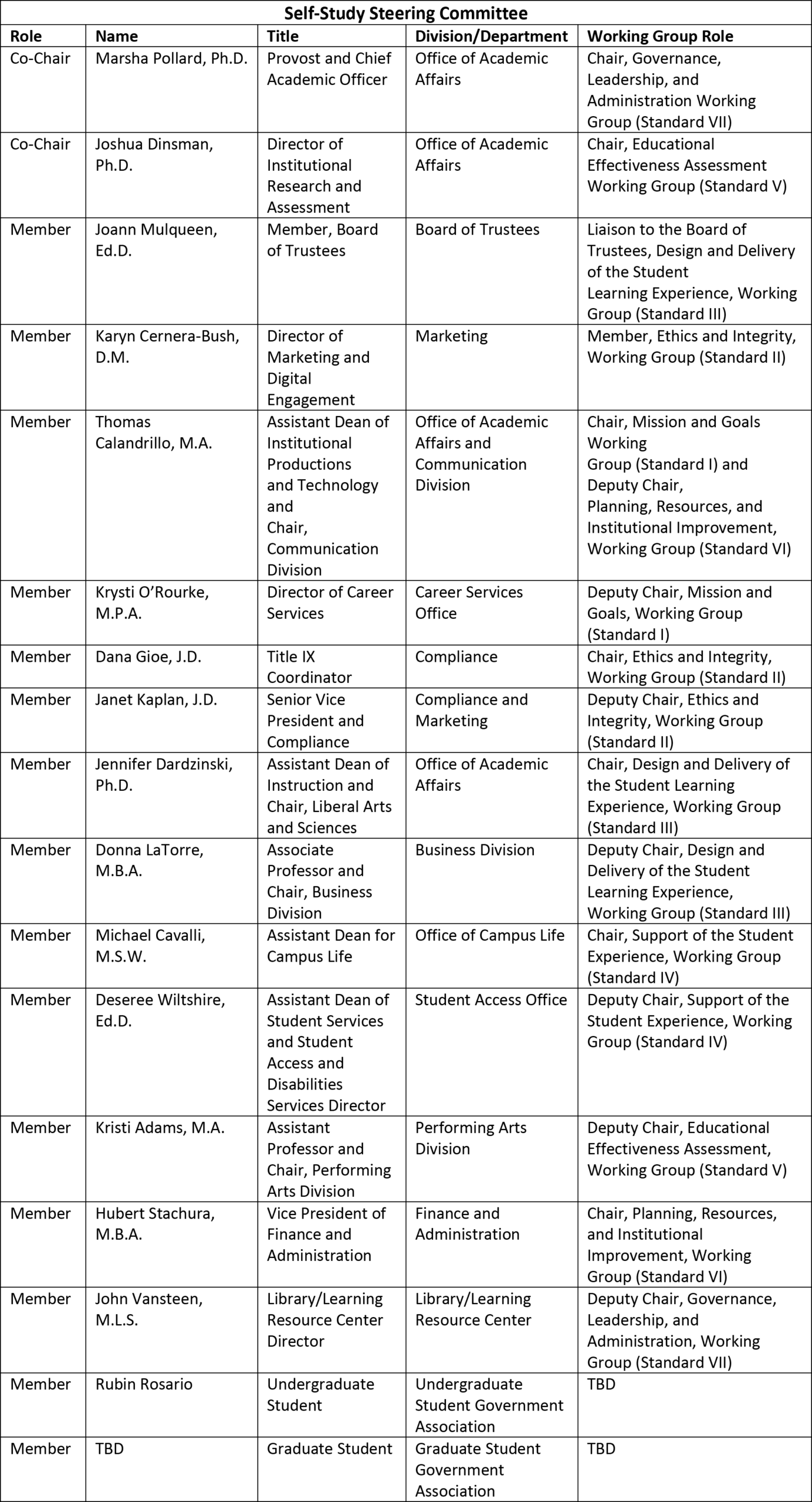
Responsibilities of the Steering Committee Include:
- Determine the Steering Committee meeting schedule and facilitate meetings;
- Review and approve the Self-Study Design and timeline;
- Review and approve the charge to the Working Groups;
- Review and approve a schedule and the communication methods to be used by and between the seven Working Groups;
- Provide leadership and guidance to the seven Working Groups and monitor their progress to ensure that all deadlines are met;
- Ensure that the Institutional Priorities are in alignment with the mission and strategic initiatives of the College, as well as the seven Standards and their related criteria;
- Provide guidance and support, including detailed guidelines and timetables, to ensure that the Working Groups fully address the assigned Standards, related Institutional Priorities, and related Requirements of Affiliation;
- Approve the lines of inquiry for each of the seven Standards of Accreditation and Requirements of Affiliation;
- Ensure that the Working Groups effectively build and use the Evidence Inventory and serve as an evidence resource to the Working Groups, as necessary;
- Ensure that the evidence collected supports the specific Standard being assessed;
- Conduct a detailed review of the external reviewers’ recommendations/comments from the 2019 Self-Study Report and ensure that they are addressed as part of this Self-Study;
- Ensure that Working Group drafts include areas of strength and opportunities for innovation and/or improvement;
- Review the drafts written by the Working Groups, provide edits/feedback as appropriate, and assist in assembling the final Self-Study Report and Evidence Inventory;
- Assist in the development and support of the Self-Study Communication Plan, ensuring College-wide knowledge of and engagement in the Self-Study process;
- Ensure the Self-Study Report and Evidence Inventory are completed and submitted on time;
- Handle arrangements for, co-develop the schedule with the MSCHE, and coordinate the Evaluation Team site visit; and Meet with the site visit team.
Working Groups
To support the Steering Committee, seven Working Groups are responsible for documenting institutional assessment according to MSCHE’s criteria outlined in the Seven Standards for Accreditation.
The working groups are as follows:
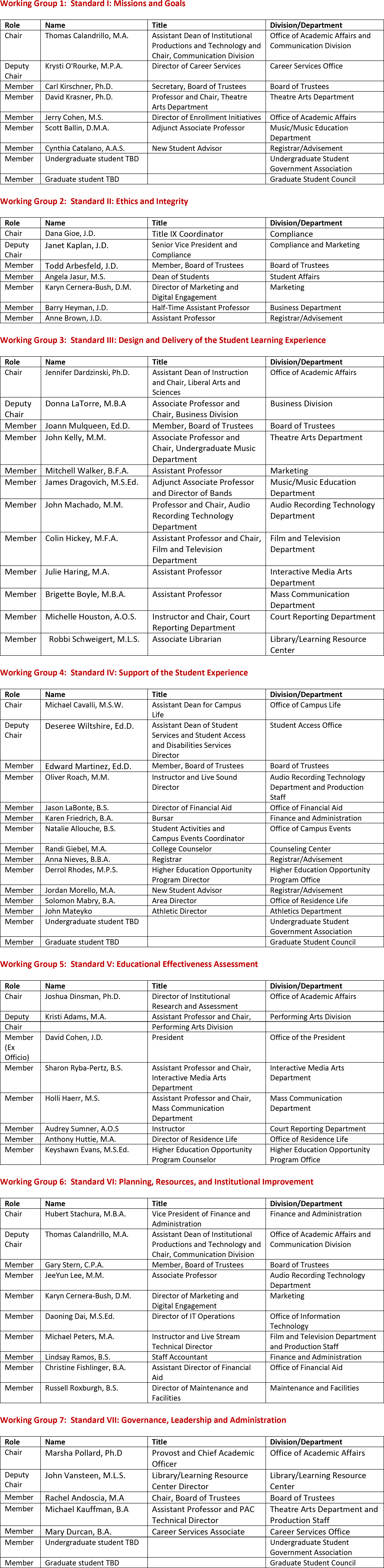
Responsibilities of the Working Groups Include:
To ensure clarity and transparency regarding decision-making processes, roles, and responsibilities, the Working Groups are charged with the following tasks:
- Develop an understanding of the seven Standards of Accreditation and Requirements of Affiliation and of the criteria under the specific Standard assigned to the Working Group;
- Examine the connection between and engage in insightful discussions and analysis about the assigned Standard and the College’s institutional priorities, its mission, and its strategic plan;
- Hold regular meetings, which should be documented in meeting minutes that are saved to the Working Group’s folder within the Evidence Inventory folder on SharePoint/ OneDrive; • Offer input and feedback to other Working Groups, when appropriate;
- Adhere to the Self-Study timeline and meet deadlines for deliverables as provided by the Steering Committee;
- Identify and collect evidence (e.g., policy documents, analyses, data set, minutes, etc.) that demonstrates compliance with the Group’s assigned Standard and that addresses the criteria under the Standard (examples of evidence documentation to be collected for each Standard are provided in Section XI: Evidence Inventory Strategy);
- Store and track all collected evidence in the Group’s assigned folder within the Evidence Inventory folder on SharePoint/OneDrive;
- Analyze evidence in relation to the Standard’s criteria and the College’s institutional priorities;
- Utilize existing assessment and institutional effectiveness data to assess the College’s strengths and weaknesses in relation to the Standard;
- Collaborate with other Working Groups and with the Steering Committee to address specific research questions/lines of inquiry, to identify gaps in the evidence or in processes or procedures, and to develop and implement strategies for addressing these gaps where feasible;
- Produce outlines, preliminary drafts, and a final 10–15-page report demonstrating compliance with the relevant Standard assigned to the Working Group. The report should address each of the criteria listed for the relevant Standard. Demonstrating compliance will involve providing evidence and creating an analytical narrative explaining how these items show that the College meets the given criteria. Based on the evidence collected and analyzed, the report will assess institutional strengths and weaknesses, identify distinction areas, and suggest improvement opportunities. The report should also provide an overview of how the Working Group addressed criteria regarding the institutional priorities they considered in relation to their assigned Standard;
- The Working Group should recognize that their submitted report will be used as source material for the Self-Study document and may or may not appear in its submitted form in the final Self-Study document;
- As the Steering Committee merges the individual Working Group reports into a single, coherent Self-Study document, the Working Group should be available to discuss revisions and answer any questions posed by the Steering Committee; and
- Participate actively in the Spring 2027 site visit.
For Students
You may not hear about accreditation every day—but it’s one of the most important things behind the scenes of your college experience.
Accreditation means that Five Towns College is recognized for meeting high standards in education, student services, and institutional integrity. It ensures that we remain eligible for federal and state financial aid, that your degree is respected and recognized, and that you’re getting a quality education that prepares you for what’s next.
Right now, Five Towns College is going through a Self-Study as part of our reaffirmation of accreditation by the Middle States Commission on Higher Education (MSCHE)—the organization that helps make sure colleges like ours stay strong, accountable, and student-focused.
Why It Matters to You
- Your education counts – Accreditation confirms that your degree holds real value and is recognized by employers, graduate schools, and other institutions.
- You help shape the future – Students are at the heart of this process. Your voice and your experiences help us identify what’s working and what we can do better.
- You can get involved – Throughout the Self-Study, students are part of working groups, conversations, and campus forums where real improvements are born. Your ideas can directly influence change.
How You Can Participate
We’re inviting students to:
- Join a virtual town hall or forum
- Share thoughts and feedback through surveys or working group discussions
- Learn more about the Middle States Standards and how they connect to your daily college experience
If you’re curious, passionate, or just want to make sure your voice is heard—we’d love for you to be part of this journey.
{Determine Town Hall Date and Provide Registration Link}
For more details about the process or what MSCHE is all about, explore the rest of this webpage. Your experience matters—and your voice can help shape the future of Five Towns College.
The Seven Standards Defined:
- Standard I: Mission and Goals – The institution’s mission defines its purpose within the context of higher education, the students it serves, and what it intends to accomplish. The institution’s stated goals are clearly linked to its mission and specify how the institution fulfills its mission.
- Standard II: Ethics and Integrity – Ethics and integrity are central, indispensable, and defining hallmarks of effective higher education institutions. In all activities, whether internal or external, an institution must be faithful to its mission, honor its contracts and commitments, adhere to its policies, and represent itself truthfully.
- Standard III: Design and Delivery of the Student Learning Experience – An institution provides students with learning experiences that are characterized by rigor and coherence at all program, certificate, and degree levels, regardless of instructional modality. All learning experiences, regardless of modality, program pace/schedule, level, and setting are consistent with higher education expectations.
- Standard IV: Support of the Student Experience – Across all educational experiences, settings, levels, and instructional modalities, the institution recruits and admits students whose interests, abilities, experiences, and goals are congruent with its mission and educational offerings. The institution commits to student retention, persistence, completion, and success through a coherent and effective support system sustained by qualified professionals, which enhances the quality of the learning environment, contributes to the educational experience, and fosters student success.
- Standard V: Educational Effectiveness Assessment – Assessment of student learning and achievement demonstrates that the institution’s students have accomplished educational goals consistent with their program of study, degree level, the institution’s mission, and appropriate expectations for institutions of higher education.
- Standard VI: Planning, Resources, and Institutional Improvement – The institution’s planning processes, resources, and structures are aligned with each other and are sufficient to fulfill its mission and goals, to continuously assess and improve its programs and services, and to respond effectively to opportunities and challenges.
- Standard VII: Governance, Leadership, and Administration – The institution is governed and administered in a manner that allows it to realize its stated mission and goals in a way that effectively benefits the institution, its students, and the other constituencies it serves. Even when supported by or affiliated with a related entity, the institution has education as its primary purpose, and it operates as an academic institution with appropriate autonomy.
The Following Five Principles Guide the Analysis in Each of the Seven Standards Because of Their Importance in Higher Education:
- Guiding Principle 1: Application of the Standards within the Context of an Institution’s Mission and Goals – The individual mission and goals of each institution remain the context within which MSCHE accreditation standards are applied. These standards intentionally emphasize functions rather than specific structures in recognition of the many different models for educational and operational excellence.
- Guiding Principle 2: Centrality of the Student Experience – Institutions should design and provide student learning experiences aligned with mission, creating an appropriately supportive learning environment and understanding and improving student learning outcomes. An institution’s student learning programs and opportunities must be characterized by rigor, coherence, and appropriate assessment of student achievement throughout the educational offerings, and institutions must offer a curriculum that is designed so that students acquire and demonstrate essential skills including at least oral and written communication, scientific and quantitative reasoning, critical analysis and reasoning, technological competency, and information literacy (Standard III). Consistent with the institution’s mission, the general education program must also include the study of values, ethics, and diverse perspectives (Standard III). Institutions must commit to student retention, persistence, completion, and success through a coherent and effective support system sustained by qualified professionals, which enhances the quality of the learning environment, contributes to the educational experience, and fosters student success (Standard IV).
- Guiding Principle 3: Reflection on Diversity, Equity, and Inclusion – Throughout the seven standards, institutions should reflect deeply and share results on diversity, equity, and inclusion (DEI) in the context of their mission by considering at a minimum: goals and actions (Standard I); demographics and policies or processes (Standard II and VII); curriculum and services (Standard III and IV); assessments (Standard V); and resource allocation (Standard VI).
- Guiding Principle 4: Emphasis on Data and Evidence-based Decision-making – The standards reflect a commitment to data-based decision-making. Institutions must analyze a range of data, including disaggregated data, to ensure students are appropriately served and institutional mission and goals are met.
- Guiding Principle 5: Innovation as an Essential Part of Continuous Improvement – Institutions are dynamic organizations that change and evolve for the benefit of their students and communities. The seven standards reflect a commitment to innovation and allow institutions to consider innovative practices in the context of mission and the students served.